
Dear Chuck,
I’m trying to teach my children/grandchildren some basic financial principles. Any tips I could pass on in regards to investing?
Motivated Grandmother
Dear Motivated Grandmother,
What a blessing for your family that you want to help them get better with their finances. It will not only help them for the here and now, but also prepare them for that day when their stewardship will be evaluated by the Lord.
Before investing, it is essential that young people understand that God owns everything and that He is their provider. This is the motivation to responsibly manage all that He entrusts to them, whether a lot or a little. This also sets their heart right to avoid investing to get rich but rather to be faithful and generous towards others.
When young people follow a few basic principles, margin is created for money to be invested. These go contrary to the way in which many Americans live today. Here is my simple list that if followed, will set them on the right path.
Establishing self-discipline early in life will enable them to live out Proverbs 21:20 which states, “The wise man saves for the future, but the foolish man spends whatever he gets.” (TLB)
It is not uncommon to find that a young person has already found themselves buried in credit card debt and is stuck in cycles of overspending. If you find that this is the case with any of your children/grandchildren, I recommend our trusted partners, Christian Credit Counselors. They have helped hundreds of thousands of people eliminate their credit card debt and rebuild their financial foundation.

Money saved is not at risk. However, money invested is at risk of loss. That’s why you should advise them to only invest money after becoming a giver and a saver. No one should invest without a purpose. So here are some questions to help establish a proper reason for investing.
Answer the following:
All of these should be considered and evaluated before any money is allocated to investment.
After setting goals, beginning investors must understand some basic investment rules. Investing is not intended to be an overnight get-rich-quick success. It is a long-term undertaking, so early investors have the advantage of giving their money time to grow.
It should not affect the daily family routine and must not cause the family stress or discord. In fact, I recommend that couples take time to discuss and pray through their goals to maintain unity. A wise spouse can offer unique insight and proper balance in decision making.
Start small and do something on a regular basis each month. It is surprising at how significant small decisions will become as the decades pass. Make sure you thoroughly understand each investment, that liquidity is important in the event of an emergency, and that diversification is key.
Think of investing like planting a tree. It could die. But if you nurture it, over time it will begin to grow and grow. The longer you allow it to remain planted in one spot, the more likely it will produce good growth yields. This is the philosophy of value investors as opposed to traders or gamblers.
Twenty-somethings have certain advantages over those who wait to begin investing, including time, the ability to weather increased risk and opportunities to increase future wages. – Jean Folger, Investopedia.com
Investing early helps you think about how you use money. When you develop Biblical financial habits early in life you are able to invest sooner. This gives you a head start and the benefit of time. Plus, you gain years of practice to help you recover from any mistakes and avoid emotional roller-coasting.
Research, Don’t Guess
Proverbs 24:3-6 (ESV) is a great verse to apply to your investing philosophy: “By wisdom a house is built, and by understanding it is established; by knowledge the rooms are filled with all precious and pleasant riches.” This means that we are to make investment choices by using our mind, not simply throwing darts and hoping to pop a balloon with a prize inside. Wisdom and knowledge are the keys to success. Diversification is Solomon’s advice in Ecclesiastes 11:2.
Most people think of the stock market when they think of investing. This would include a variety of choices for publicly traded securities such as:
But don’t forget other choices like real estate, starting a small business, or investing in a privately held company.
Finally, especially when it comes to your grandchildren, teach them to invest in themselves early in life to gain the education, skills, and wisdom to reach their income earning potential. One of the highest returns on any investment relative to temporal returns is to make ourselves more valuable whether as an employee or entrepreneur. God is honored when we become excellent at whatever we are called to do.
I encourage you to follow through with your desire to pass along God’s principles to your children and grandchildren. What a blessing it will be to see what incredible returns will happen in their lives as you make these deposits of love and wisdom. Go, Grandmother, Go!
This article was originally posted on The Christian Post August 21, 2020.
Dear Chuck,
My wife and I are considering buying a house now although it’s a year earlier than we planned. We don’t know if the low rates will be available next year. Should we go for it?
Buy or Hold?
Dear Buy or Hold,
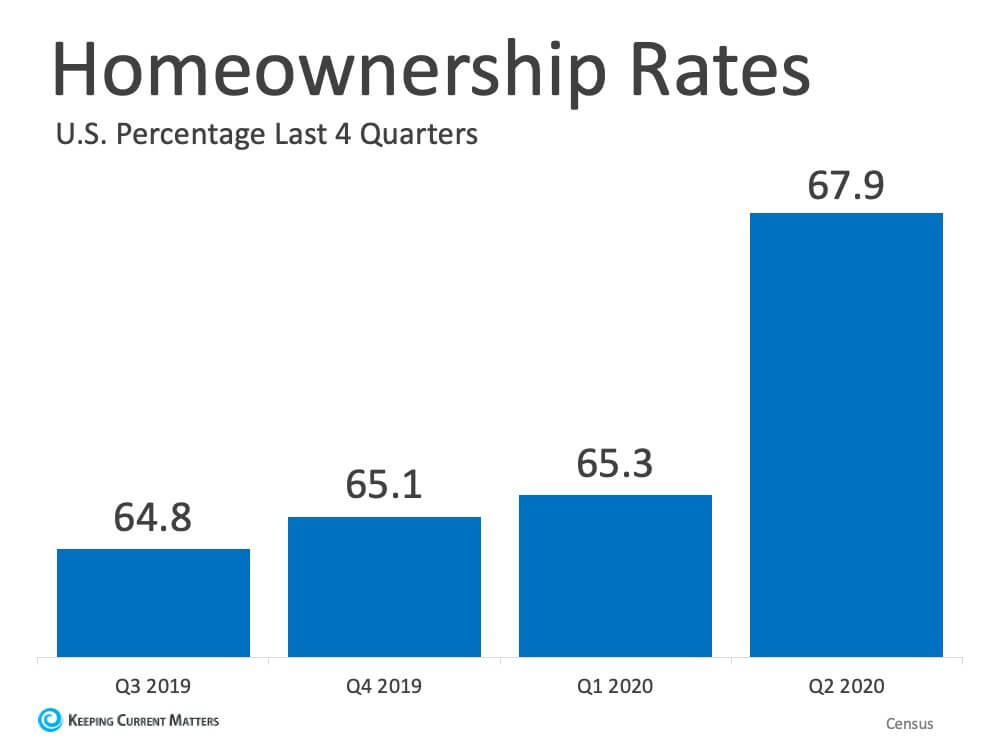
You and your wife are not the only ones with this mindset. Homeownership is on the rise in different parts of the United States. People have been stuck at home with time to research available inventory in different parts of the country. The historic low mortgage rates and pandemic fears along with the flexibility of remote work are propelling many to buy. Some are seeking to leave areas where crime and disruptive protesting have impacted their livelihoods.
It is a good time to buy a home, but only if you are ready. Let’s look at the trends first then some pros and cons of buying now.
(Image source: https://www.keepingcurrentmatters.com/2020/07/29/homeownership-rate-continues-to-rise-in-2020/)
You can read Zillow’s Forecast here. I have pulled some of the highlights which point out that rates are low, but so is inventory:
Low mortgage rates are poised to stay for a while, so buyer demand should stick around even as seasonal headwinds start to form. Although, there are some storm clouds gathering. Broader uncertainty due to the surge in coronavirus cases and the prospect of disappearing fiscal support pose looming limitations as well. Historically low levels of for-sale inventory also has the potential to thwart the strong gains the housing market has recently enjoyed, and while for-sale inventory rose slightly in June, inventory remains significantly below last year’s levels. The coming months will be a true test of the housing market’s enduring strength and resilience.
There are benefits to homeownership that include safety, security, and accessibility to desired education and lifestyle opportunities. Habitat for Humanity acknowledges the crucial role of homeownership in society:
Habitat for Humanity knows that safe, decent and affordable shelter plays an absolutely critical role in helping families to create a new cycle, one filled with possibilities and progress. Affordable homeownership frees families and fosters the skills and confidence they need to invest in themselves and their communities. The outcomes can be long-lasting and life-changing.
Studies conducted by academics and experts draw a straight line between housing quality and the well-being of children. Surveys of Habitat homeowners show improved grades, better financial health, parents who are more sure that they can meet their family’s needs. Wherever we work, we witness tangible evidence that strong and stable homes help build strong and stable communities.
The biggest financial decision most of us ever make is buying a house. Too often in America, we find couples who are “house poor.” This means that they were convinced they should stretch to buy a home in their preferred neighborhood, their preferred school district, or with their preferred amenities, only to get several months into it and find they stretched too far.
If your total housing expense–which includes your rent or mortgage, insurance, taxes, maintenance, and utilities–is 40% or more of your total income, it will likely cause financial stress. Plus, it restricts the ability to give, save, and invest.
Keeping your total housing expense at 30% or below will relieve a great deal of stress. Have a look at our free mortgage amortization calculator. Be sure to include these items in your budget:

But godliness with contentment is great gain, for we brought nothing into the world, and we cannot take anything out of the world. But if we have food and clothing, with these we will be content. (1 Timothy 6:6-8 ESV)
It is always good to be patient. I am curious as to why you were planning to buy a year from now. If you were waiting to save more for a down payment, or to be in a better position with moving expenses, by all means, wait. Those who are content and patient make far better decisions than those who are hasty and impatient.
I hope this helps you to make a better decision. My guess is that mortgage rates will be low for quite some time, so be patient and make a wise decision that will bring you and your family years of joy.
This article was originally published on The Christian Post, August 14, 2020.
Dear Chuck,
Gold is soaring now. Should I buy gold before our economy tanks?
Gold Fever
Dear Gold Fever,
I’m probably going to step on some toes because people have very strong opinions about gold.
Gold, speaking of the tangible metal, is an asset, a commodity, and makes for a good insurance policy–but not a great investment. It provides no income stream and does not earn dividends. It can be difficult to trade. People have made and lost money trading gold in the stock market, while others have profited mining it, using it for ornamental purposes and as a base metal.
Gold is a medium of exchange–if people want it. During a crisis, other things may prove to be more valuable such as food, medicine, transportation, shelter, etc. Some view it as a hedge against inflation. Others see it as a speculative asset that varies in price according to the emotion of the market. Gold can be held in the form of gold futures, gold coins, gold mining companies, gold ETFs, gold mutual funds, gold bullion, and gold jewelry.
The U.S. abandoned the gold standard in 1971 when our currency was no longer backed by gold, but is still important globally. Early in 2019, the World Gold Council reported that central banks throughout the planet bought the most gold in 2018 in over 51 years. Central banks bought 651 tonnes (metric) of gold, an increase of 74% from 2017. The biggest buyers were China and Russia.

When gold hit an all-time high recently, it confused experts. It usually rises when stock prices are falling or when inflation is rising. None of those things happened. Was it due to the worsening U.S.–China relations, the economic distress of the coronavirus, or the weakening U.S. dollar? It is a mystery but could be all of the above.
Warren Buffett does not consider it a worthwhile investment:
Gold is a way of going long on fear, and it has been a pretty good way of going long on fear from time to time. But you really have to hope people become more afraid in a year or two years than they are now. And if they become more afraid you make money, if they become less afraid you lose money, but the gold itself doesn’t produce anything.
I wrote about gold and diversification back in 2012 based upon Biblical principles.
Solomon, in his wisdom, offers an excellent investment strategy in Ecclesiastes 11:2: Divide your portion to seven, or even to eight, for you do not know what misfortune may occur on the earth. Solomon found that the only path to peace of mind in investment planning was to diversify and surrender the outcome to God. Based on this, it would be wise for investors to make informed choices that are spread out to cover the various categories of the investment spectrum.
Many investors today are hoarding precious metals, especially gold, as economic crisis insurance. Caution and preparation are wise, but no one can prepare for every possible calamity. Because the buying and selling of precious metals is oriented more toward a long-term investment strategy, any long-term financial planning could conceivably include the purchase of some precious metals.
Generally, though, the only people who are able to make money with precious metals are the brokers who live off of gullible amateur speculators. Nevertheless, if an investor is interested in investing in precious metals, he or she should limit his or her investment to no more than 5 to 15 percent of the total investment portfolio.
Precious metals are long-term stores of value and internationally recognized assets of last resort. They can diversify and stabilize a person’s portfolio, they can protect it against market fluctuations, and they do offer insurance against a currency collapse.
However, precious metals are volatile, speculative, high-risk investments. This investment area is for the investor with a strong heart and cash only. Unless an investor can afford to lose what he or she has invested, this is probably not an area in which a person would want to risk a lot of money, especially savings or retirement funds.
Although a portion of an investor’s investment portfolio could include precious metals, these will probably not protect an investor from financial misfortune in case of an economic crisis.
Choose my instruction instead of silver, knowledge rather than choice gold, for wisdom is more precious than rubies, and nothing you desire can compare with her. (Proverbs 8:10-11 ESV)
This article was originally published on The Christian Post, August 7, 2020.
Dear Chuck,
The government is talking about a second round of stimulus money – is it real? What should I do with it?
Watching for Money in the Mailbox
Dear Watching for Money in the Mailbox,
You are correct; the government is discussing the passing of another stimulus package. The Republican Party offered a $1 trillion proposal while the Democrats want $4 trillion. Treasury Secretary Steven Mnuchin wants $1,200 stimulus checks to be sent in August. But don’t assume that new money is on its way; there are qualifiers. Those making less than $75,000 will qualify for the full amount, those earning above $100,000 will not qualify, and those in-between will receive less than $1,200.
Based on the timing of the first CARES Act, we can make some predictions on when checks might be sent. If the current proposal passes the Senate and the House before the August recess, the first checks could be sent out by the week of August 24. If it doesn’t pass until after the recess, the checks could be sent the week of September 28.

Stimulus money is an unexpected windfall. It was never in your budget to begin with, so it offers lots of good options for improving your finances, if used wisely. Here are my thoughts and tips.
Crown is privileged to partner with Christian Credit Counselors to help free individuals and families from the burden of credit card debt. Their Christ-centered values and experienced team of friendly and professional counselors make their partnership an integral part of Crown’s mission to help individuals and families. If you need a debt management plan, this is a good time to contact them for their help.
You may be in a position to invest the money in a Health Savings Account (HSA), 401(k), a Roth IRA, or Taxable Investment Account. Or, invest in yourself via classes, certifications, online degrees, an upgraded computer, or equipping a home office.
Protect yourself from scammers. Don’t fall for the fake phone call from the “treasury department” needing your bank account information so they can make a transfer!
Don’t blow it in foolish ways. The government hopes that you will go out and spend the money quickly. It is better to be slow and deliberate before making a decision of what you should do with it.
Americans who are struggling should focus spending on immediate needs: housing, utilities, food and health care. Those who are at least 62 years old and are unable to make ends meet with the stimulus check may benefit from taking Social Security early. It can make sense for other reasons as well, making it worth the time to do some research.
The way we use stimulus money is an indication of what is in our hearts. God wants us to be faithful to Him when it comes to managing all money. Consider these passages:
One who is faithful in a very little is also faithful in much, and one who is dishonest in a very little is also dishonest in much. If then you have not been faithful in the unrighteous wealth, who will entrust to you the true riches? And if you have not been faithful in that which is another’s, who will give you that which is your own? (Luke 16:10-13 ESV)
This is how one should regard us, as servants of Christ and stewards of the mysteries of God. Moreover, it is required of stewards that they be found faithful. (1 Corinthians 4:1-2 ESV)
You and I are stewards of all that God provides, including stimulus checks! Put God first and manage it with the intention of pleasing Him.
This article was originally published on The Christian Post, July 31, 2020.
Dear Chuck,
I’m hearing more and more about a “cashless society.” What can we as believers do to prepare for such a possibility and how should we navigate the days ahead?
Prepping for Digital Currency
Dear Prepping for Digital Currency,
This is not an easy question as there are many strong, differing opinions; some say that it absolutely is going to happen, and others say that it absolutely will never happen.
A 2019 Harvard Business Review article points out that 30% of all transactions happen with cash. They don’t think it is likely to ever be eliminated as a form of payment. On the other side of the argument, a BBC article suggests it will get here sooner than we think. I fall somewhere in the middle as to the probability of it happening. But, to your point, we do need to be informed and prepared.
A cashless society means absolutely no cash. That means transactions will be fully digital and fully controlled. While many young people welcome it since they are almost there already, the idea deeply concerns me.

The most used form of payment today is debit cards, followed by cash. The coronavirus caused many to fear using cash because of possible transmission of the virus, even though there is no proof that paper money carries the virus any longer than plastic cards.
On July 14, 2020, an article from Bloomberg CityLab stated:
A June report from Square showed that at the start of the pandemic in March, 8% of U.S. sellers were effectively cashless, meaning that at least 95% of their sales were made through credit or debit card. That figure jumped to 31% by the end of April and has since leveled off at 20% in mid-June as cities reopen. In the U.K., cashless sellers jumped from 10% to 60%, according to the Square analysis, and dropped just slightly to 57% in June.
Cash carries more emotion for buyers. The loss when making a purchase is felt immediately. As CEO of a ministry that tries to help people steward their money, I’ve seen people improve their spending habits due to the psychological effect of using cash.
We’ve seen the use of cash discouraged and even refused by certain vendors. However, cashless stores were banned in San Francisco, New Jersey, and Philadelphia on the grounds of discrimination.
These factors could either propel or delay the push towards going cashless, so don’t make a determination too quickly one way or the other.
GlobalData predicts the following countries are poised to go cashless this decade: Finland, Sweden, China, South Korea, United Kingdom, and Australia.
Obtaining cash is getting more expensive. About 2 million Britons use cash day-to-day. However, 9,000 free-of-charge ATMs closed over the last two years, but cash machines that charge a fee for withdrawals increased 40% within a year. Negative interest rates will have an impact as well.
The International Monetary Fund (IMF) blog posts articles that reveal interesting data and political leanings. This one pushes the cashless move. However, the assistant director of the National Consumer Law Center, Lauren Saunders, says, “The cashless movement is a dangerous movement.”
Although disturbing, some are concerned with the government “unbanking” political enemies. Government control would also eliminate those who hoard cash or drop out of the financial system. The idea of the government being in control of all citizen money is concerning.
Protection is important. Supposedly, digital wallets are more secure than debit and credit cards because only the wallet providers see your information. Passwords and biometric authentication (retina scans, face, fingerprint, and voice recognition), auto-lock screens will be imperative to protect phones and accounts. This leads to even less privacy and ultimately less freedom once your biometric ID is used for all online access.

In Revelation 13, John describes the second beast that rises out of the earth:
Also it causes all, both small and great, both rich and poor, both free and slave, to be marked on the right hand or the forehead, so that no one can buy or sell unless he has the mark, that is, the name of the beast or the number of its name. This calls for wisdom… (v16-18a ESV)
Many believers see this verse pointing to a one-world government, headed by the Antichrist, that has absolute control over the entire global economic system. A global cashless society would be a step in making that control possible.
There are only two ways to be prepared for a cashless society. One is to grow in wisdom.
If any of you lacks wisdom, let him ask God, who gives generously to all without reproach, and it will be given him. But let him ask in faith, with no doubting, for the one who doubts is like a wave of the sea that is driven and tossed by the wind. (James 1:5-6 ESV)
Wisdom allows you to look at the facts and make appropriate decisions. We do not know if this trend is going to take us into a cashless society or not. That means we do not need to waste time in fear and needless use of energy to protect ourselves from it. At the same time, if we do head that direction, it will be wisdom which proves of greater value than our money.
The other way to be prepared is to be sure that your life is not defined by or controlled by money. The Bible tells us over and over to keep our lives free from the love of money. This allows us to avoid hoarding or the emotional fallout from losses. Our treasures have never been on Earth; therefore, whether we are cashless or not, we will never lose our true riches which are stored in Heaven.
If you’re looking for practical ways to prepare for these possibilities and seek to grow in wisdom, Crown offers many online studies, videos, and more on our online platform.
This article was originally published on The Christian Post, July 24, 2020.
Dear Chuck,
I am 46 years old. My company is closing its doors due to COVID-19. I have been adding to my 401(k) for 21 years. What do I do with it now?
Concerned About My 401(k)
Dear Concerned,
Thanks for the great question. Millions of people are facing a similar challenge. I will offer some explanation of the 401(k) program and some advice.
401(k) accounts are employer-sponsored defined contribution plans that function as tax-deferred retirement accounts. Employees who participate determine an amount to have taken out of their paychecks and directly sent to their 401(k) investment accounts. These may include mutual funds, exchange-traded funds, and target-date funds. Growth in 401(k)s have increased because pensions are less common.
More than 80 million workers actively participate in 401(k)s, with more than half-a-million different company plans in place, according to a January 2019 report by the American Benefits Council. Overall, a dizzying $5.7 trillion in assets are held within 401(k)s in the U.S.
Federal law requires employers to keep 401(k) funds separate from company assets. This prevents creditors from gaining access to it. You should be able to keep most of the funds and move them to another type of account.
Be sure to keep a record of your 401(k) accounts, all other bank or financial institution accounts, and important documents such as insurance policies, deeds and contracts. When there is turnover in the economy and moves like you are making now are happening more often, it is easy to lose track of transfers and financial accounts.
Millions of dollars are left unclaimed in everything from safety deposit boxes, bank accounts, savings accounts and retirement accounts each year. People simply forget they have the account or die without notifying their heirs of where the money was placed. It would be similar to having a storage facility that nobody ever knew about. All of your efforts to save are wasted which is poor stewardship.
The Bible reminds us to stay on top of the details: Know well the condition of your flocks, and give attention to your herds, for riches do not endure forever; and does a crown endure to all generations? (Proverbs 27:23-24 ESV)
It is not uncommon for me to hear from people who are losing money in their investment accounts, especially those who are making passive investments in a 401(k) or 403(b). Both of these accounts offer pre-packaged investment options so investors assume that making a quick choice is all that is necessary. Remember to do your homework on those choices and seek counsel from professional advisors or experienced investors who can help you with your asset allocation within your retirement accounts.
Proverbs 15:22 (NIV) is a great investment principle to put into practice: Plans fail for lack of counsel, but with many advisers they succeed.
God bless you as you seek your next work assignment. Don’t forget, we offer career coaching services as well. Learn more here.
This article was originally published on The Christian Post, July 17, 2020.
Dear Chuck,
I plan to get married soon. My future wife and I plan to combine our money at that point. We both have checking and savings accounts. What banks do you recommend?
Choosing a Good Bank
Dear Choosing a Good Bank,
I always like to say that marriage is a lifetime of learning to make good decisions together. Your question about a bank is a practical one, and is only just the beginning of thousands of more decisions you will need to make together.
Marriage is about becoming one. One in everything: name, address, bed, and money. Keeping anything separate, including checking accounts, develops a “his money, her money” philosophy, which usually leads to a him-versus-her mentality. There should be no “his money” or “her money” in marriage. It’s God’s money that we manage together. So let me give you enough information to help the two of you make a united choice on where you bank.
I would never deposit money in a financial institution that did not provide evidence that your deposits are insured by the Federal Deposit Insurance Corporation (FDIC) or the National Credit Union Administration (NCUA) which cover up to at least $250,000 per depositor.
Bankrate.com offers an excellent in-depth analysis of savings accounts.
Also check out Magnify Money’s list of:
The only reason to maintain separate accounts is for business purposes; for instance, to manage accounting for expenses associated with one’s job. Joint accounts require you to relax your grip on money. Rather than being “mine” or “yours,” it becomes “ours.” It requires mutual respect, honest communication, and working together for a common good. You can no longer justify selfish spending because in marriage, you are called to serve one another.
Joint accounts simplify bill paying and force earnest cooperation. Trust can be established and accountability expected. Common goals can be met through teamwork. Love and respect are foundational in stewarding the money you share in a common account. Money is a means by which God reveals our strengths and weaknesses and teaches us to depend on Him more fully.

Open new accounts before closing any existing accounts. Keep enough in them to meet the required minimum balance and to cover any automatic payments or checks that have yet to clear. Change direct deposits to the new accounts and adjust bill payments to begin once your first direct deposit goes through. Once all automatic transactions have cleared, you can empty and close your old accounts. Depending on the institution, this can be done over the phone, in writing, or in person. Verify that all transfers have occurred.
There are a number of good reasons to build a long-term history with a single institution. You will likely garner the maximum customer benefits if you maintain healthy balances and keep your accounts in order. Over time, you will achieve a valued customer status which may help if you ever encounter problems such as identity theft or need a loan or other assistance.
I hope this helps you and your fiancée make the decision together. The best decision will be one in which you are united, regardless of the bank you choose.
This article was originally published on The Christian Post, July 10, 2020.
Dear Chuck,
2020 has been a year of ”unexpecteds.” My wife is pregnant and we are growing concerned about raising a child in the city. We are considering moving since both our jobs offer online flexibility. Any advice? Thanks for your ministry.
Headed for the Suburbs
Dear Headed for the Suburbs,
First of all, congratulations on your pregnancy! Sounds like this may be your first child, hopefully of many more!
We are seeing an “urban exodus” brought about by many pressures for those living in major metropolitan areas. The coronavirus, political and social unrest, taxes, along with the cost of living, are weighing heavily on many people that populate our cities.
Some see the current threats as irresolvable. Many, weary of months in small apartments with young children, want space. Some have lost income, making city life unaffordable. A desire to work somewhere with open skies, a backyard, and friendly neighbors are luring many to the suburbs and country. They want peace and are moving to find it. Some justify second homes in the country as a necessary retreat from the city.
A Harris Poll taken in April 2020 found that nearly half of urbanites had browsed online for places to rent or buy away from less densely populated areas. The great migration of 2020 in the U.S. is to suburbs, self-reliance, and even off-grid living.
Real estate searches in suburban zip codes jumped 13% in May. Homes in certain areas sell within hours or result in bidding wars. People, desperate to leave cities, are buying homes sight unseen. Online real estate websites include Zillow, Trulia, Redfin, Homesnap, and Realtor.com. NeighborhoodScout.com grants access to information by address or area although a fee is required for in-depth analysis.

Rent or Buy
With interest rates so low, many see mortgage loans within reach. Bankrate.com offers current rates and calculators if buying is on your radar. Do not stretch to buy with the economy being so unstable or neglect an adequate emergency fund. Even though you both can work remotely, be sure your job security is strong before making a final decision. Check out my article on renting versus buying a house to help you make a rent-or-buy decision.
Moving Costs
Don’t forget to budget for moving costs, such as:
Get Informed
Familiarize yourself with the area. Drive through neighborhoods. Talk to residents. Ask questions. I’ve done this everywhere I’ve purchased a home. You will learn things about the homeowner association, schools, community, and more. A familiar area near friends or family can prove helpful with a baby on the way.
Research
The Bible tells of several men moving their families to escape dangerous times. A famine in Canaan led Abraham and Sarai to Egypt (Genesis 12:10) and Elimelech, Naomi, and their sons to Moab (Ruth 1:1). An angel warned Joseph to flee for protection in Egypt with Mary and Jesus (Matthew 2:13).
Ask God to give you clear direction. Pray with your wife. Seek counsel from wise people. Then move forward in faith knowing this: In the fear of the Lord one has strong confidence, and his children will have a refuge (Proverbs 14:26 ESV).
This article was originally published on The Christian Post, July 3, 2020.
Dear Chuck,
We anticipate two of our girls will be getting married in the near future. Due to the uncertainty with COVID and the economic setback in our family business, we are unsure how to proceed. Any advice?
Father of the Brides
Dear Father of the Brides,
These are in fact strange times for those who are planning a wedding. Two of my four sons are married. My experience is that it is a lot easier being on the groom’s side of planning. One had a church wedding and the other eloped. The second told us ahead of time. They came to our house afterward where we surprised them with cake and wedding gifts. Both events were celebrated. One was far less expensive for the bride and groom’s family than the other and both marriages are doing fine.
I once read an article that argued the higher the cost and the lower the attendance at a wedding, the less likely the marriage would work out. The inverse was also true, the lower the cost and the higher the number of guests in attendance, the more likely the marriage would last.
I’m a firm believer in planning for a marriage, not just a wedding. Far too many people invest tens of thousands of dollars in weddings with very little thought of future financial stewardship.
My advice: keep it simple with the focus on Christ and the wedding covenant.
In 2019, Trip Savvy reported the average American wedding costs just under $35,000. That’s a WHOLE lot more than Ann and I spent on our wedding! Most couples don’t have that kind of cash, and it’s a lot to ask of parents. Here is a good way to avoid the financial stress of your daughter’s marriage: don’t borrow money for a wedding. Instead, create a reasonable wedding budget and let your children use every dollar saved for their future. If you can afford $5,000 and they can do it for $3,000 then bless them with the $2,000 saved.
Humility and beauty under the umbrella of faith will testify of God’s goodness on their wedding day. The example you set could bless many. My observation is that the simpler the plans, the less stress is typically involved. The Bible says, Anxiety in a man’s heart weighs him down, but a good word makes him glad. (Proverbs 12:25 ESV)

First, make a budget for the rehearsal, wedding, and reception. Then, involve family and friends to help with everything from food and flowers to invitations, music, and photography. You will be surprised at how much friends from church or family are willing to do to help make the day special.
Marriage Preparation: One way to help your children prepare for marriage is by getting them started off on the right foot financially. Our Money Dates will give them a firm foundation in Biblical stewardship.
The Dress: 80% of Western wedding dresses are manufactured in China. One of my nieces is a bridesmaid for an August wedding. Her dress was ordered months ago but was recently informed that her dress would not be ready until that month. If you have a daughter, I recommend buying a dress off the rack. We attended a beautiful simple wedding where the bride wore a dress she found on sale at Anthropologie. Think outside the box and don’t let the world dictate your decisions. Years ago, my wife loaned her dress to two people: a good friend and a relative. One of my sisters-in-law wore her grandmother’s.
Guest List: Some experts predict the coronavirus to increase due to travel, ongoing protests, and virus mutation. This could impact the size of the weddings. Considering flight restrictions, think about your out-of-town guests. Remember that older people are the most susceptible to the virus, so precautions will be needed. Consider allowing people to join the wedding from a distance by streaming it live on the internet.
The Location: With the increase in destination wedding locations such as on the beach, in a barn or outdoor venues, costs can vary greatly. Consider lowering your cost by going the old fashioned way of using your home church. If your wedding and reception can be managed at your church, you will likely save lots of money. One simple wedding we attended in a church just a few years ago had the wedding party singing a beautiful hymn as they proceeded down the aisle. The bride and groom joined in the final stanza as their guests stood and sang along. I can hardly remember the other elements of the wedding, but that feature was so beautiful that it has remained in my mind.
Honeymoon: The average couple spends more than $4,000 on their honeymoon, but it is not necessary. If you already have credit card debt, and need help eliminating it, reach out to Christian Credit Counselors to help you get started on a debt management plan before the weddings. With the travel restrictions experienced this year, a honeymoon planned in a safe location within driving distance may be less stressful. If you know someone who has a lake house, cabin, or second home, ask if you can use it. People are typically thrilled to provide in such a way. If that is not an option, inexpensive vacation options are available. A weekend away may fit the budget now with the hope of a later trip when the economy rebounds. Many couples enjoy a later honeymoon after they have a few months to adjust to being married.
This is a one-day event so keep an eternal perspective. Don’t allow the world to dictate your plans. My prayer is that you and your daughters are pleased with the wedding, avoid financial stress, and set them up for a wonderful marriage.
This article was originally published on The Christian Post, June 26, 2020.
Dear Chuck,
I wasn’t ready for the pandemic. My health has been fine but my finances have not. How can I get ready if we are faced with another crisis?
Prepping for Another Pandemic
Dear Prepping,
I am sorry you were not ready for the pandemic but I am grateful that your health is fine. By the way, nobody saw this coming and thus it was very difficult to be prepared. However, we can go through some Biblical financial advice that will help you prepare for the next round or the next pandemic or whatever the Lord brings our way.
2020 has been a year of the unexpected. Experts say we need to brace for a rise in coronavirus cases due to travel, ongoing protests, and virus mutation. We have political and social unrest, fear, and insecurity on many levels. It is definitely time to get your financial house in order. This will give you the freedom to make wise decisions and reduce stress.

Do you remember the story of the humble man who surprised his community by dying with millions of dollars? Ronald Read, of Vermont, served in WWII. He returned home to work at a service station for 25 years, then as a janitor for 17. The unassuming man grew up poor but had an incredible work ethic. He drove a used Toyota Yaris and was known for his flannel shirt and baseball cap, sometimes holding his coat together with safety pins. What people did not know about this incredibly frugal man is that he studied The Wall Street Journal and bought stock. Upon his death at 92, he left six million dollars to his local library and hospital.
There are some lessons to be learned from his life. He was not interested in “keeping up with the Joneses.” He made sacrifices to save and invest so he could give – generously. Spending less than he earned gave him the margin needed to accomplish his goal. He not only survived many crises in his long life; he thrived.
Last year, GoBankingRates.com conducted a survey and reported that nearly half of all Americans live paycheck to paycheck. Income isn’t necessarily the problem; spending is a key factor. A survey by global advisory firm Willis Towers Watson found that 18% of people earning more than $100,000 live paycheck to paycheck.
The three costliest items for Americans are housing, transportation, and food. Finding ways to reduce these can significantly improve your financial condition.
Get a group of trusted friends to join you. No plan is the same for everybody, but we all benefit from encouragement and accountability. Seek ways to increase your income while decreasing your expenses. Sell what you don’t need and ask God to grant insight in ways to boost your income.
The wise man saves for the future, but the foolish man spends whatever he gets. (Proverbs 21:20 TLB)
A great way to get started is to use tools designed to help you move toward healthy saving habits. The Eli app is a tool that helps automate your savings for you. You could also try using an envelope system or budget spreadsheet. There are other free resources on the Crown website.
The Bible teaches that we are to give first and save second. Support your local church and organizations committed to helping the poor. See how your church can partner with other churches or organizations to help. Then volunteer your time.
Our hope is in the future promises of God. We can joyfully make sacrifices now so we are prepared for tomorrow. The margin we create allows us to help others who do not have the capacity or ability to help themselves.
Stay healthy! Stay prepared! Thanks for writing.
This article was originally posted on The Christian Post, June 19, 2020.
