
Dear Chuck,
I would love to treat my family to a vacation, but we just can’t afford it unless we put it all on a credit card and pay it out over the coming months. Seems worth it to us. We need a break.
Vacations Via Credit Cards?
Dear Vacations Via Credit Cards,
Happy June! School’s out, and many are looking forward to a traditional summer vacation to a theme park, the beach, or even bucket list travel destinations. Others, like you, do not see how they can afford one. The truth is, you need a vacation; that is non-negotiable. But paying it out over months of high interest rates is not wise.
Vacations Are Vital
Vacations are permissible, profitable, and, more importantly, Biblical! An article at Forbes, “Why Taking Vacation Time Could Save Your Life,” makes the case that time off is “integral to well-being, sustained productivity and high performance.”
The Harvard Business Review offers this compelling article: “Thinking of Skipping Vacation? Don’t!” Research shows that taking regular vacations grants greater job satisfaction. Those who take ten days of vacation are 30% more likely to get a raise. “Research on elite athletes shows that rest is what enables them to perform at peak levels, and the same is true for us.” Another HBR article to reference is: “We All Really Need a Vacation. Here’s How to Make the Most of It.” The article states, “Even before the pandemic, millions of days of vacation time went unused in the United States.”
This article at Very Well Mind addresses burnout prevention and managing stress. “How to Take a Break from Work” says time off is needed when these signs are evident:
Even if these signs are not present, because we are made in God’s image, we all benefit from rest. If He rested, we certainly can’t ignore our need for rest! The break in routine can rest your mind and body, but sticking to clear parameters will prevent financial stress upon your return home.

Steps to A Vacation You Can Afford
A debt-free vacation is possible if you do it on a budget! Be realistic about what you can afford. Planning a vacation without debt requires cooperation, planning, perseverance, and, perhaps, some painful sacrifices, but the reward is worth it. Spend some time researching costs; then set a financial goal and get started.
Assess your financial situation. Try cutting back your variable expenses to accumulate some cash. If the family works together, you can jointly agree on things like not eating out for a month and giving up certain activities, foods, subscriptions, or new clothes. How about having a garage sale or selling larger items on Facebook Marketplace?
Consider driving to see friends and family or receiving them at your home. Camp, stay in state and national parks, spend time in nature, and simply unplug. Enjoy a staycation, and take advantage of all the free or low-cost experiences near your home. Invite other families to join you. It can be a truly enjoyable time for all! If you cannot afford a summer vacation, save for a fall or winter one. You can find great rates in the off-season!
Vacation Without Overspending
According to a survey by Accrue Savings on travel and vacation habits:
Managing Family Expectations
It is easy to overspend when away from home because people let down their guard. They relax and treat themselves to new activities, souvenirs, drinks, and once-in-a-lifetime experiences. Some find it easier to give in to a child or spouse than answer with a loving, “No, we can’t do that this year.” Discuss the situation, and try to teach basic financial principles before leaving home. Then hold one another accountable. You might want to enact a no-complaining rule.
Perhaps you can surprise the family with special treats purchased or prepared ahead of time. Carrying food and drinks with you is usually more affordable than buying on location. If driving, bring books, journals, pens, pencils, games, and in-car entertainment to pass the time. Limit or avoid screen time so the family is truly present—communicating with one another and enjoying the scenery. Plan family devotions and time to praise and worship God.
Set a New Standard
Please get away and rest, but try to avoid doing it with debt, which will only add financial stress to back-to-school and holiday expenses coming in the Fall. I have a wealthy friend who annually pitches a tent in a state park just an hour from his home in North Carolina. He and his wife spend the weekend completely unplugged from the world. Although he could afford a 5-star hotel, this is one of his favorite ways to recharge. He inspires me to find ways to set a new standard for how I steward my vacation expenses.
Crown has a number of resources available to assist in budget planning, including calculators, online courses, and even personal budget coaches. If we can help your family get on the road to financial freedom, please reach out, and we would be honored to help.
This article was originally published on The Christian Post on June 2, 2023.
Dear Chuck,
I am 25, live in a hot housing market, and feel squeezed by rising rents. I can’t see any way that I could ever buy a home! I need a plan and some hope.
Sick of Paying Rent
Dear Sick of Paying Rent,
We are in a very unique time when millions of renters are motivated to buy a home but feel trapped. Hopefully, this will not last too much longer. In the meantime, there are steps you should be taking now.
The Refinancing Boom
There was a refinance boom during Covid-19. Mortgage rates fell dramatically, and 14 million mortgages were refinanced. A 30-year mortgage fell to 2.65% in early January 2021, which allowed average homeowners to decrease monthly payments by $220. Others took advantage of 15-year mortgages, which dropped to 2.16%. Although monthly payments increased, these borrowers were motivated to save tens of thousands of dollars in interest while building equity faster than a 30-year mortgage.
Those desiring to buy a home today are struggling to find what they want because many homeowners do not want to sell. Mortgage rates are near 7%, and home prices are still high. These are disincentives.
According to Market Watch, “The mortgage refinancing boom is over, but its impact will be seen for decades to come,” said Andrew Haughwout, director of household and public policy research at the NY Fed.
Research shows that the refi boom of 2020-2021 differed from booms in 2003 and 2013 in three specific ways: interest rates were historically low, home equity was at an all-time high, and the rebound in rates was historically steep.
Count the Costs
When calculating the ability to buy, do not forget to add in the costs of property taxes, insurance, utilities, and HOA fees, along with emergency funds for maintenance and repairs. Consider additional costs for landscaping, furniture, window coverings, and décor. Take into account future expenses: child care, private education, braces, pets, college, vehicles, weddings, continued inflation, and unexpected costs, like caring for a family member or a loss of income. Depending on the climate, you may have expenses for snow removal, tree maintenance, and after-storm care. Will there be greater transportation costs? Needs arise out of the blue.
Experts recommend the 28/36 rule when buying a home:
If you are married, I recommend buying a house based on the lower of the two salaries because that provides flexibility in the use of a spouse’s income for greater saving, investing, or future goals. It also provides some protection in the event of job loss or if one of you chooses to pause your career.

Start Now; Prepare to Buy When the Market Changes
First, you should begin now to save for a down payment:
Next, be patient as you watch for mortgage rates to drop and more home inventory to come on the market in your area. When you think you are ready to buy, create a budget with a proposed mortgage payment. Include all expenses you may encounter. Do not fudge. It is wise to buy in a price range that keeps your expenses in a similar range as your rental costs, if possible. Buying too much house impacts saving for retirement, paying off debt, traveling, and the freedom to give as the Lord directs. It can create stress that affects your marriage and career. Just because you qualify for a more expensive home does not mean you should buy one!
Praise God for the place you live now. There are many benefits to renting that are not available to homeowners. Remember to number your days, for we are all just passing through. Steward wisely, and live intentionally with your “future home” in mind. Our hope is in the life to come, not in this one.
If credit card debt is a concern, Christian Credit Counselors is a trusted source of support. Getting out of debt can certainly help with your goal of home ownership. Reach out to them today; they may greatly benefit you.
This article was originally published on The Christian Post on May 26, 2023.
Dear Chuck,
I work and live with those who buy whatever they want, whenever they want. I find myself constantly influenced to join their spending sprees! Can you give me any tips that I can implement to control my spending immediately?
Spending Too Freely
Dear Spending Too Freely,
Yes, I can help you—been there, done that! Living in debt is deceptive. I once saw a sign that described what it was really like living beyond our means and on ever-increasing debt: “I started out in life with nothing, and I have most of it left!”
Based on consumer credit statistics, you are not the only one struggling. For the first time in more than 20 years, credit-card debt failed to fall between the fourth and first quarters. The U.S. credit card debt level is approaching a historic high of $1 trillion.
Find a Great Example to Watch and Learn From
Early in our marriage, my wife, Ann, worked with a remarkable single mom. She immigrated to the United States with her former husband, who was a soldier at the time. Shortly after they arrived in this nation, which was very foreign to her, she delivered their child, and he exited their lives. She found herself alone, without sufficient resources, without support systems, and facing a daunting challenge to make it all work.
We got to know her through work, but she became a close personal friend. Immediately, her habits stood out to us: she carried her simple lunch every day, including a dessert of 10 chocolate chips in a reusable sandwich bag (without the cookies). Rather than joining a fitness club, she walked ten flights of stairs each day after lunch in the bank building where she worked for slightly above entry-level pay. Her frugality kept her fit in mind, body, and finances. She earned a college degree and paid for a house and her daughter’s education. She eventually married.
Interestingly, this was also during a time of high inflation in the 80s. Mortgage rates soared to 17%! Although a painful time in many ways, she found joy in spending far less than she earned; she kept a budget, set goals, and made steady progress with her humble, disciplined lifestyle. She never complained. We actually were the ones most impacted after she spent time in our home over meals and holidays.
Know Where Every Dollar Is Going
Today, our economy is on shaky ground. I recommend using a budget and then applying the tips below to change your habits, prepare for the future, and live on less. Ann and I have learned to be frugal without missing out on life. We have found unexpected joy in saving money and becoming more generous.
Increase Your Savings
Build your emergency fund to avoid having to borrow or use a credit card. Stop all impulse spending, and reduce debt so you can pay off all bills each month. By eliminating interest charges and penalties, you take a step back from the financial cliff. Implementing a frugal lifestyle will give you extra money to deposit in a fund each month. Set up an automatic deposit, and increase the amount over time.
Time with Friends/Entertainment
If your friendships are not beneficial to you and your budget, make new ones. Volunteering is a great way to broaden your community. Enjoy budget-conscious friendships by going on walks, visiting museums, or taking advantage of free events. Listen to books, and work puzzles. Gather friends to play board games, hike, or bicycle. Pack a picnic, and meet at a park. Plan a potluck. Ask others to join you in a no-spend month. Make it a time to share budget-saving ideas and encouragement. Those you think don’t need to watch their spending may join you so they can save or give more. Consider the fact that they may be living a lifestyle that hides financial pain.
Limit/Drop Social Media Plus a Few Other Things
Scan credit card and bank statements for items to drop, like subscriptions and memberships. Instead, use the library or YouTube for free. Read for personal development and financial prowess.

Food
Gasoline
Reduce driving, compare prices (GasBuddy.com), carpool, bike, walk, and work remotely when possible.
Utilities
Clothing
Shop thrift/resale shops and yard sales, accept hand-me-downs, and borrow for special occasions. Aim for quality, not quantity. Get creative, and remake clothes. Cut off a dress for a new blouse. Convert pants to a new pair of shorts. When shopping online, put items in your shopping cart, then wait and compare prices for several days. It is likely you can live without them.
Self-Care
Take care of yourself but in a cost-efficient manner. Extend the time between hair or manicure/pedicure appointments. Or temporarily do without. Eliminate other expenses, or trade skills for essential services.
Wait, Wait, and Wait Some More!
The wise man saves for the future, but the foolish man spends whatever he gets.
Proverbs 21:10 TLB
Learning to delay gratification and wait for what you need pays big dividends. God can surprise in amazing ways! It is a sign of wisdom according to the Proverbs.
Christian Credit Counselors is a trusted source of support in assisting people with getting on the road to financial freedom. Reach out to them today; they may be of great benefit to you.
This article was originally published on The Christian Post on May 19, 2023.
Dear Chuck,
I am a baby boomer with lots of friends and a healthy community at church, but I see loneliness as a major problem for so many of my friends, our kids, and our grandkids. How do you think this trend will impact the economy in the future?
Worried about the Disconnected
Dear Worried about the Disconnected,
I am glad to hear of your concern for the disconnected and your insightful connection of this problem with economics. Loneliness is truly a devastating and costly problem.
Loneliness is no longer a problem that affects just the elderly or shut-ins. Three years after Covid-19 lockdowns and restrictions, reports reveal that loneliness has become a public health crisis. The U.S. Surgeon General recently addressed the issue: Our Epidemic of Loneliness and Isolation.
According to the Harvard Health Blog, “Isolation is the objective measure of how large your social network is, whereas loneliness is a subjective perception of how one feels. In other words, you can have many friends and be lonely, or no friends and not be lonely.” However, isolation is a risk factor for loneliness.

The High Cost of Loneliness
The CDC reports that social isolation and loneliness cost the U.S. economy an estimated $406 billion a year, in addition to approximately $6.7 billion in annual Medicare costs. The socially isolated are more likely to need skilled nursing care in a facility. This becomes very expensive to beneficiaries because of limitations in Medicare coverage.
A study by the University of Chicago found that loneliness can be as debilitating as anxiety or depression. High blood pressure, heart disease, obesity, and a weakened immune system, along with cognitive decline and Alzheimer’s, are linked to it, increasing the risk of premature death. The disabled, those with poor physical and mental health, single parents, and the financially insecure particularly suffer. Research shows that social isolation is as bad as smoking 15 cigarettes per day or drinking six alcoholic beverages a day. This is a serious and costly issue.
God created us to thrive within a community. Busyness, technology, and social media cannot substitute for in-person socialization. Without it, there is a price to pay:
Financial Behavior of the Lonely
A study out of Hong Kong reported that the lonely or rejected tend to put a greater value on money. They often make risky financial decisions that offer high rewards. They spend money, often sacrificing important resources, in an effort to secure social bonds, fit in, or be accepted. Those who place their identity in money feel pressure to be financially successful. They may forfeit time with family and friends to reach goals while damaging the quality of their relationships. Loneliness can also follow sudden wealth because people often don’t know who to trust. It is easier to build walls of protection than determine who is truly genuine.
“I cannot even imagine where I would be today were it not for that handful of friends who have given me a heart full of joy. Let’s face it, friends make life a lot more fun.”
–Chuck Swindoll
Some Helpful Action Steps
The lonely commonly withdraw, which only exacerbates the problem. One must step out of comfort zones to conquer loneliness. If a child or spouse is suffering, find ways to broaden their activities. Seek wise mentors, trusted friends, family members, or coaching to aid in social skills. Ask God for help, and see who He brings into your life. When we moved to a new city, my wife and I prayed for local couple friends, and the Lord graciously provided. Mayo Clinic reports that friendships enrich your life and improve your health.
Here are some helpful tips:
It takes work to make and maintain relationships, but it is so beneficial. Invite someone to walk and talk. Spend some money on an experience that is good for your mental health. Do not wait for someone to call or invite you somewhere. Reach out first. You may discover that person is just as hungry for friendship as you.
“The dearest friend on earth is a mere shadow compared to Jesus Christ.”
–Oswald Chambers
If you’re looking for a way to help others or make connections, consider starting a small group or volunteering. Here is a Crown resource that you might find beneficial. Thank you for the excellent question.
This article was originally published on The Christian Post on May 12, 2023.
Dear Chuck,
We have a budget, but the cost of groceries and eating out is ridiculous! Something has to change. What can we do? We are exceeding our food budget every single week.
Fed Up with Grocery Prices
Dear Fed Up with Grocery Prices,
You are correct. Something does have to change for almost all of us who are being pinched by the price of food. I am fortunate that my wife, Ann, who does research on all of my articles, is also a great grocery shopper, so I asked her to contribute her insights, which greatly helped my reply.
Has Greed Taken Over the Food Industry?
Hmm, supply-chain issues have been resolved, cost pressure from the war in Ukraine has eased, stores are stocked with inventory, compulsive pandemic shopping has ended, and employees gained higher wages, so why are grocery prices still inflated? Have you heard of “greedflation”?
Eggs are 70% more expensive than they were a year ago, with many stores limiting purchases to two dozen. Other staples remain elevated in price, while only a few things have come down. Several explanations are possible. Mergers in the food industry have resulted in few competitors. Profit hoarding, or as some call it, “greedflation,” occurred when corporations amplified disruptions to their benefit. See the staggering numbers here or in the graphic from Time Magazine below.
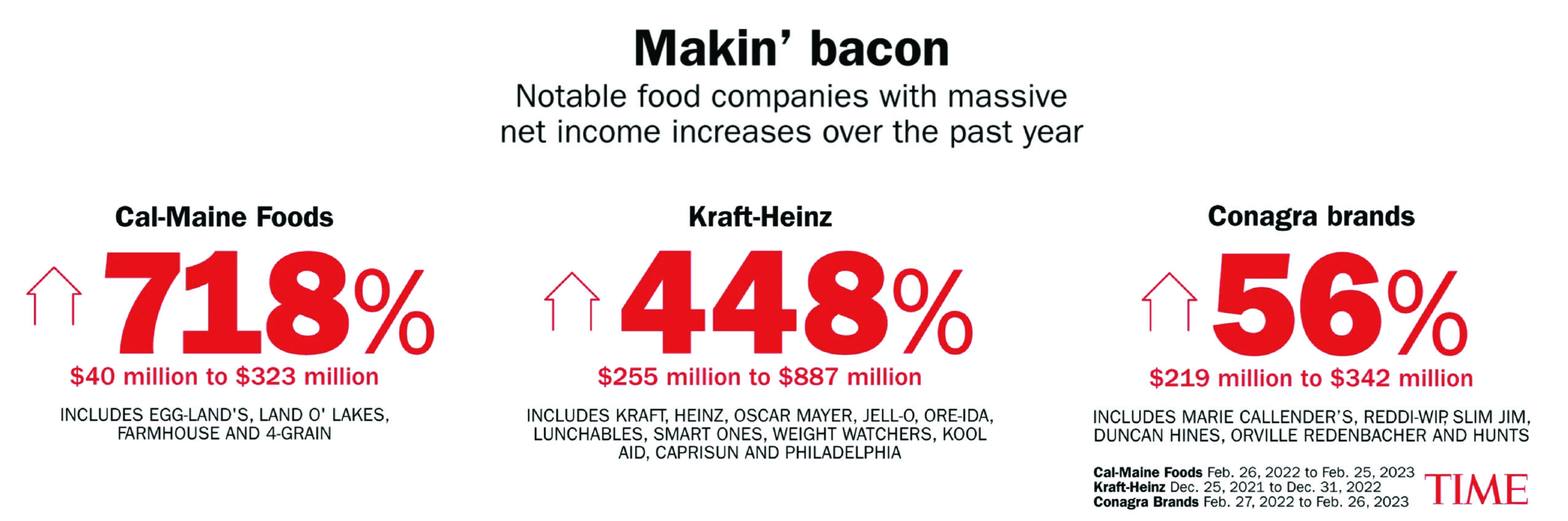
Businesses know that people will pay more for what they want, so getting them to forfeit profits will be tough. The ultimate solution will come when leaders are willing to sacrifice millions (billions) of dollars in bonuses, perks, and salaries for the good of the nation. Inflation tends to be “sticky” or hard to get rid of. Don’t count on it going away soon; so in the meantime, you must get proactive.
Ideas from Ann, My Money-Saving-Grocery-Shopper Extraordinaire
One obvious way to reduce your bill is to go on a diet. Seriously!
Reduce your consumption of sugar, meat, soda, juices, alcohol, and prepackaged foods/snacks. Compare unit prices using a calculator if necessary. A shopping list app or shopping guide may be helpful. In addition, avoid eating out for a month, and see how much you save. Here are some other helpful hints:
Wonder what you should be spending? The USDA compiled a Thrifty Food Plan Cost guide.

The internet offers many budget-saving recipes. Bon Appetit even has a list of cheap dinner ideas.
Become an expert at saving money on groceries. Meet regularly with friends to share cost-saving tips and recipes. Notify one another of sales, and share items you find. Learn to make all that you can from scratch, from salad dressings to snacks. Involve the whole family, and praise each other’s attempts to fight this battle.
Try not to complain, especially in front of your spouse or children. Remember the Israelites whom God rescued out of Egypt? He provided for their every need, yet they failed to meditate on His goodness. They did not give thanks. Instead, they wept in self-pity and said, “Oh that we had meat to eat! We remember the fish we ate in Egypt that cost nothing, the cucumbers, the melons, the leeks, the onions, and the garlic. But now our strength is dried up, and there is nothing at all but this manna to look at.” (Numbers 11:4–6 ESV)
Being mindful of this, focus on what you do have. Ask God for help. Then give thanks, and celebrate discounted items or delicious cost-saving recipes you find. Enjoy potlucks with friends or neighbors. Enjoy a “Cheapest Meal Competition”—that must also be delicious! Try memorizing Psalm 100, and give thanks at every meal. Pray for those who literally have no food or can only afford one meal a day.
Thank you, Ann.
Economic Cycles
It has been said that the best cure for high prices is high prices. People tend to pull back spending when it no longer makes sense; thus, demand drops until prices also decline. By becoming more frugal during this time, your spending habits will help accelerate a price adjustment in the long run. Thank you for the question.
The Crown God Is Faithful devotional can offer some inspiring and practical Biblical wisdom in such uncertain times. You can subscribe to receive daily devotionals that will help transform your finances and provide much-needed encouragement. May it be a blessing!
This article was originally published on The Christian Post on May 5, 2023.
Dear Chuck,
I would like to eliminate our high interest credit card debt. What are your thoughts on taking out a HELOC to pay it off?
HELOC or NOT?
Dear HELOC or NOT?
Just to be sure readers know what we are talking about, HELOC stands for Home Equity Line of Credit. It is a line of credit that uses the equity in your home as collateral. Because of high interest rates and inflation, more and more homeowners are using a HELOC. The rates are usually more favorable than other forms of consumer debt, especially credit cards. This revolving line of credit is quickly replacing the older method of “cash out refinancing.” It can be helpful when used wisely because it gives homeowners access to equity to help meet cash flow needs—emphasis on the word wisely.
General Thoughts on HELOCs
Paying off credit card debt can be a good use of a HELOC for the disciplined spender. You must strive to reduce the use of credit cards and faithfully pay off the balance every month to avoid accumulating high cost debt again. Know, too, that if repayments of the loan are missed, you face the danger of foreclosure. So your decision must first be based upon your personal discipline to keep within a budget and a plan.
A home equity loan pays a lump sum at a set interest rate, whereas a HELOC allows funds to be taken as needed. This keeps monthly payments lower and helps avoid unnecessary debt. Some nominal costs are involved, and interest is only charged on what is borrowed. However, the rate is typically variable, and the payout period ranges from 10 to 20 years.
To qualify, verifiable income, good credit, and considerable equity are needed. Reliable payment history may be investigated. See Bankrate.com or Forbes for current HELOC rates. Lenders will use Loan-to-Value (LTV), Combined Loan-to-Value (CLTV), and Debt-to-Income (DTI) ratios as well as other factors to determine individual interest rates and the amount eligible to borrow.
Terms to Know
Pros
Cons

When to Use
When to Avoid
HELOC or NOT?
The best use of a HELOC is to increase property value. The risk is that one’s home is used as collateral. If convinced this kind of borrowing will be beneficial, compare rates and fees of different lenders. Understand the repayment structure and all requirements before signing any paperwork. What is the prepayment fee and policy? Does a low monthly rate come with a balloon payment? Will a shorter repayment timeline grant a lower rate? Is there an inactivity fee? Does your bank or credit union offer member discounts?
Once the loan begins to amortize, monthly payments can be painful unless the borrower is disciplined and prepared. That is why I recommend that a payback plan be in place before borrowing any money.
“The rich rules over the poor, and the borrower is the slave of the lender.” (Proverbs 22:7 ESV)
The Bible warns of debt becoming a form of slavery. Avoid presuming on the future—especially during uncertain economic times. And do not borrow to simply keep up with friends or neighbors. While a HELOC can be helpful in extreme cases, I always think it is best to make a plan to pay off the debt causing you pain without creating more debt. For most people, this is a safer and wiser path to financial freedom.
My bottom line: paying off high debt with a low rate HELOC can be wise if the Lord directs you in this way. Pray for wisdom.
Christian Credit Counselors is a trusted source of support in assisting people with getting on the road to financial freedom. Reach out to them today; they may be of great benefit to you.
This article was originally published on The Christian Post on April 28, 2023.
Dear Chuck,
My husband and I believe America has lost its way. I see so much pride, division, financial fear, and greed that I wonder if we can even recover. How can an individual make a difference?
Overwhelmed by America’s Decay
Dear Overwhelmed,
You, like so many others, are expressing a sense of gloom that has come over the nation. As believers, we are inwardly groaning at what we see happening to the nation that once stood as a beacon of light to a dark world. And your concerns are reflected in the data.
According to findings in a recent survey by the Wall Street Journal, traditional or core American values are declining, while the value placed on money is increasing:
The loss of values that unite and the increase in the value placed on money are dangerous trends. Most tension, family friction, strife, anger, and frustration are caused directly or indirectly by money. Christians have access to Biblical financial principles, but do we implement them? Many do not—either by choice or ignorance.
Love Is Not Proud
C.S. Lewis called pride “the great sin.” He said, “Pride is spiritual cancer: it eats up the very possibility of love, or contentment, or even common sense.”
If we humble ourselves before the Lord, individuals can make a difference, and God has given us clear instructions on what we are to do!
God is love and desires that we use what He provides, whether great or small, to love Him and others. Jesus said, “You shall love the Lord your God with all your heart and with all your soul and with all your strength and with all your mind, and your neighbor as yourself.” (Luke 10:27 ESV) This applies to every area of our lives—even finances. Do you know anyone who models this well? If not, can I challenge you to become that person? The world needs examples!
Below are three ways you can begin to make a difference.

Financially Love Your Family
No matter how much our culture drifts away from God, we are to care for the needs of our families. This includes their financial, spiritual, and emotional needs:
Financially Love Your Church
We can plug into our local, Bible-believing, gospel-centered church and support its mission and programs. Change happens in community, and the church was created to strengthen one another as we serve others in love:
Financially Love Your Neighbors
We are to care for one another in word, deed, and dollars:
America Is Not Our Home
The core problem is that the world has been ravaged by sin since Adam and Eve disobeyed God’s commands. We need personal redemption from the sin that has controlled us and a kind and generous heart toward those who remained trapped in the darkness.
While we are blessed to live in America, I am constantly reminded that it is only our temporal home. Let’s do all we can to be salt and light until our journey here is complete.
The Crown God Is Faithful devotional can offer some inspiring and practical Biblical wisdom in such uncertain times. You can subscribe to receive daily devotionals that will not only help transform your finances but will also provide much-needed encouragement. May it be a blessing!
This article was originally published on The Christian Post on April 21, 2023.
Dear Chuck,
Our finances are stretched so thin that I am stressed out all the time. We live on a budget, but my husband and I both need some hope that it will not always be this way.
Living on a Financial Cliff
Dear Living on a Financial Cliff,
There is certainly reason for hope, so hang on!
Let’s put your challenges in a current economic context and then a Biblical context before I offer some practical tips to help you through this painful time.
Economic Context
With the lingering impact of inflation, a new CNBC survey reports that 70% of Americans say they, too, are feeling financial stress, and 58% report they are living paycheck to paycheck. The report pointed to several specific concerns, including a lack of savings and a dependency on debt.
“People are worried that the money they’ve saved won’t last and are worried they’re going to have to lean more on their credit cards and other sources of debt just to get by,” said Bruce McClary, a senior vice president at the National Foundation for Credit Counseling.
With rapidly increasing costs, higher interest rates, and a sense of economic uncertainty in the air, many are feeling like their finances are balanced on a razor’s edge with no margin for error.

Biblical Context
The Bible is full of people who had to face incredible amounts of stress. It is also full of principles and truth that help us to reframe our present circumstances. I am reminded of Romans 8:18–21:
I consider that our present sufferings are not worth comparing with the glory that will be revealed in us. For the creation waits in eager expectation for the children of God to be revealed. For the creation was subjected to frustration, not by its own choice, but by the will of
the one who subjected it, in hope that the creation itself will be liberated from its bondage to decay and brought into the freedom and glory of the children of God. (NIV)
We live in a fallen world—in bondage to decay—because of mankind’s disobedience to God, but a promise of freedom and redemption awaits those who are children of God. Considering our eternal future, our present trials and tribulations are insignificant. Remember to keep your present cares and burdens in the context that this is not our home. We temporarily manage what God provides and seek to be faithful until we have finished our race.
Help in Reducing Your Financial Challenges
Three very practical steps will help you reduce the immediate pain you are in.
First, no matter how much or how little income you have each week or month, be sure that you are spending less than that amount. Think of the old game of limbo, where you have to bend your body to get under a bar without knocking it off. The bar represents your income. Your attempts to get under it represent your control over your spending. That is why a budget is so very helpful. You can adjust your expenses to ensure that you never exceed the height of the bar (your weekly or monthly income).
Second, build an emergency savings fund. You need at least $1,000 set aside to help with unexpected expenses. That is the bare minimum. Set a goal of saving three months of overhead. Emergencies always happen, so this is non-negotiable. In the CNBC survey, most of those who report living paycheck to paycheck say they do not have any money saved. This is like flying through the air on a trapeze bar without a safety net. It is scary! Crown has some free tools to help you get that accomplished. Perhaps you need to adjust your budget. You might benefit from our budgeting resources and a coach.
Finally, make a plan to reduce your debt and break any dependence on credit cards, store accounts, buy-now-pay-later plans, or payday loans. The largest expense in most American budgets today is interest expense on debt. Just imagine how free you would feel without debt hanging over you each month. We partner with Christian Credit Counselors to help free people from this burden.
Thank you for writing. Please know that we want to help! May God give you His peace and the freedom you so desire.
Christian Credit Counselors is a trusted source of support in assisting people with getting on the road to financial freedom. Reach out to them today; they may be of great benefit to you.
This article was originally published on The Christian Post on April 14, 2023.
Dear Chuck,
It sure looks like Larry Burkett’s book “The Coming Economic Earthquake” is happening before our very eyes! Is this the big one that he warned us about?
Economic Observer
Dear Economic Observer,
It would be hard to overestimate the number of times I have been asked this question in the past 22 years that I have worked with Crown. So my answer is always the same, “No, not yet.” Let’s review a few key points from Larry’s book that you referenced, and then I will add my thoughts about the times we are in now.
The Coming Economic Earthquake
Larry authored his best-selling book in 1991. Within the pages, Larry discussed economic history, the US government’s violations of Biblical principles of sound money, and the plausible scenario for what could happen to the debt-fueled American economy. He was careful to say that he was not a prophet, nor could he tell the future, but he was compelled to warn about the possibility that America’s economy could be destroyed within ten years of the publication of his book. That was 32 years ago.
Fortunately, the American economy has survived a number of very significant challenges since then, including the Great Financial Crisis of 2007–2008. Larry’s timing was way off. He was labeled an alarmist, and many discredited his thesis altogether. But let’s take a look at the argument that Larry made and compare it to where we are now, three decades later.
At that time, an estimated 20% of the annual budget deficit was funded by foreign investors. That number has increased to 30% in the estimated federal budget proposed for the coming fiscal year.
An article on Schiffgold says: “Since March 2020, the federal government has added $4.7 trillion to the national debt. And as WolfStreet put it, the Federal Reserve went ‘hog-wild’ with debt monetization. . . . At some point, the central bankers will be faced with a choice – continue monetizing the debt and inflating the money supply or deal with surging inflation by letting rates rise. It can’t do both. And neither of these choices will play out well for the American people.”
As Larry Burkett said, “What is the national debt but the visible indicator of gross fiscal mismanagement on the part of our leaders?”

Where Are We Now?
All of the warning signs that Larry wrote about are certainly still in play. In fact, they have been every year since he first penned the book; however, the American economy has shown incredible resilience to shocks and has expanded more than Larry may have ever dreamed or imagined. Through economic expansion and federal monetary policy, “the big one” has been staved off far longer than Larry and many other experts thought would be possible.
In Deuteronomy 28, God gave clear economic instructions to His chosen people: “And if you faithfully obey the Lord your God, being careful to do all his commandments that I command you today, the Lord your God will set you high above all the nations of the earth.” The promises for obedience that follow are for blessings of abundance and strength, including verse 12b: “…And you shall lend to many nations, but you shall not borrow.” However, the curses for disobedience would undo all their progress, including verses 43–44: “The sojourner who is among you shall rise higher and higher above you, and you shall come down lower and lower. He shall lend to you, and you shall not lend to him. He shall be the head and you shall be the tail.”
America was the largest creditor nation in the world in the late-‘70s but flipped to the largest debtor nation in the world by the mid-’80s. Our nation is facing an ever-increasing mountain of debt and a potential banking crisis while attempting to control inflation and fight off a recession or worse. I cannot help but believe it is all related to our declining interest in obeying God. The heart of our economic problem is truly the heart problem of our people. Until we believe God is needed here, we should not expect to avoid an economic crisis.
An economic earthquake will come; we just don’t know when.
In such uncertain times, the Crown God Is Faithful devotional can offer some inspiring and practical Biblical wisdom. You can subscribe to receive daily devotionals that will help transform your finances and provide much-needed encouragement. May it be a blessing!
This article was originally published on The Christian Post on April 7, 2023.
Dear Chuck,
This banking crisis has me nervous. How bad is it? Should we trust our small regional banks? Where should we put our money?
Widowed and Worried
Dear Widowed and Worried,
As you are, we should all be concerned and paying attention. This is a very real and dangerous economic challenge.
What Happened?
Silicon Valley Bank and Signature Bank are the 2nd and 3rd largest bank failures in U.S. history, topped only by Washington Mutual, which collapsed in the financial crisis of 2008. 94% of Silicon Valley’s deposits were uninsured, as were 90% at Signature. SVB had a concentration of tech startups, and Signature had a significant number of holders of cryptocurrencies. Together, the banks held combined assets of nearly $320 billion.
The assets at SVB were too heavy in long-term treasury bonds that were purchased before the Fed raised interest rates. Their value decreased as investors preferred new bonds that earn higher rates. Rather than analyzing the market value of the bonds, the accounting value gave a false portrayal of the bank’s status. To calm a run on banks, the current administration guaranteed uninsured deposits at both banks, and the Federal Reserve announced a lending program for institutions needing to borrow money to cover withdrawals. Over time, the FDIC fund will have to be replenished, possibly by a “special assessment” on banks that customers will undoubtedly have to pay in fees.
“The principle of sound money was ignored by the Fed. SVB violated principles of diversification and prudence. It set aside its fiduciary duty to steward the assets of others and focus on business, not ideology.” (Jerry Bowyer)
Bank Contagion
I don’t pretend to be an economist or understand the complexity of the current banking crisis. I do know that the First Republic Bank is also distressed and had to be rescued by its rivals. Credit Suisse, a century-old European stalwart bank, had to be rescued by rival UBS (United Bank of Switzerland) for it to remain solvent. While some are calling for more bank reform and regulation as the solution, the Federal Reserve is working overtime to stop runs on banks and ease the fears of depositors like you and me. By some indications, as of this writing, those measures are working to diminish the fear of a complete banking meltdown.

What To Do with My Money Now?
An in-depth article in Fortune Magazine gives insight into the history of bank failures and some helpful advice on managing your bank accounts. Here are a few tips from my perspective:
The Economic Finger Trap
One side of our economic challenges can be solved by controlling inflation, which requires raising interest rates. The other side can be controlled by increasing liquidity in our banks, thereby increasing inflation. Some say the Fed will be choosing between generational inflation and another banking crisis in the days ahead.
“A prudent person foresees danger and takes precautions. The simpleton goes blindly on and suffers the consequences.”
Proverbs 27:12
The coming days will be interesting indeed. This should be a wake-up call to millions of people, especially Christians. We need to live prepared for any of these possible scenarios.
The Crown God Is Faithful devotional offers inspiring and practical Biblical wisdom. You can subscribe to receive daily devotionals that will help transform your finances and provide much-needed encouragement. May it be a blessing!
This article was originally published on The Christian Post on March 24, 2023.
